Coils and e-liquids explained
How to choose the right e-liquid for your coil and e-cigarette
When you start vaping, you quickly discover that coils, PG, VG, and e-liquids have enormous significance for the overall experience. Flavour, vapour production, throat hit, and how well your e-cigarette functions largely depend on the combination of coil and e-liquid.
Many new vapers experience problems such as poor flavour, leakage, spitting, or burnt coils, simply because the liquid does not optimally match the coil or tank they are using. Therefore, it is important to understand how coils work, what the difference is between PG and VG, and how to find the right balance.
There is no one perfect solution for everyone. The best vaping experience often involves experimenting with different coils, wattages, and liquid mixtures until you find the combination that best suits your personal preferences.
What is a coil in an e-cigarette?
The coil is the heart of any e-cigarette. It is the part of the device that heats the e-liquid and converts it into vapour. Inside the coil is a metal wire surrounded by cotton or other absorbent material, which absorbs the e-liquid from the tank or pod.
When you activate your e-cigarette, power is sent through the coil, which quickly becomes hot. The heat then vaporises the liquid from the cotton, and it is this vapour you inhale.
The coil has enormous significance for the entire vaping experience. It affects, among other things, how much vapour is produced, how warm the vapour feels, how intense the flavour becomes, and how strong the throat hit is experienced. Therefore, the same e-liquid can taste very different depending on which coil and tank it is used in.
Most coils have a specific resistance measured in ohms. The resistance indicates how much power the coil requires to function optimally. The lower the resistance, the more power and heat the coil typically develops.
Coils with higher resistance, for example, 1.2 or 1.8 ohms, are often used for classic mouth-to-lung vaping, where the experience is more reminiscent of a traditional cigarette. These coils produce less vapour, use less power, and typically work best with thinner e-liquids.
Coils with lower resistance, also called sub-ohm coils, produce much more vapour and operate at higher temperatures. They are typically used for direct lung inhalation and require thicker e-liquids with higher VG content.
Coils over 1.0 ohm – the classic vaping experience
If you are new to vaping, you will often start with coils over 1.0 ohm. This type of coil is found in many pod systems and beginner-friendly e-cigarettes from brands like Aspire, Innokin, and Joyetech.
These coils are designed for a more calm and controlled vaping experience. They typically provide a tighter inhalation, which is more reminiscent of the feeling of traditional cigarettes. At the same time, they use less battery and less e-liquid, making them popular among new users and former smokers.
For this type of coil, e-liquids with a 50/50 PG/VG blend are often recommended. The thinner liquid penetrates the cotton more easily and helps the coil stay saturated with liquid. This reduces the risk of dry hits and simultaneously extends the coil's lifespan.
Many users also find that the flavour becomes more pronounced in high-ohm coils, especially with fruit, menthol, and tobacco flavours. This is partly because PG carries aroma better than VG.

Sub-ohm coils and more powerful vaping
Sub-ohm vaping means using coils with a resistance below 1.0 ohm. This type of coil is designed for users who want larger vapour clouds, stronger flavour, and a more intense vaping experience.
When the resistance becomes lower, more power is drawn from the battery. This means the coil heats up faster and at higher temperatures. The result is much more vapour and a richer flavour experience.
Sub-ohm coils are often used with more powerful vape mods from brands like SMOK, Vaporesso, Geekvape, and Voopoo.
This type of vaping usually requires e-liquids with higher VG content. VG is thicker than PG and works better at high temperatures. Using too thin e-liquid in a sub-ohm tank can lead to leakage, spitting, and unstable performance.
As a rule of thumb, 70VG/30PG works really well for most sub-ohm coils. Some very powerful coils even work best with Max VG liquids.
Sub-ohm vaping often provides a smoother inhalation with less throat hit, but much larger vapour production. Therefore, many also choose lower nicotine strengths for this type of device.
What is e-liquid?
The complete guide to PG, VG, nicotine, and vape liquids for e-cigarettes
What is e-liquid?
E-liquid is the liquid used in an e-cigarette to create vapour. When the e-liquid is heated by the coil inside the tank or pod, the liquid is converted into vapour, which is inhaled. It is also the e-liquid that largely determines the entire vaping experience. The flavour, amount of vapour, throat hit, and the feeling of inhalation all depend on how the liquid is composed.
Modern e-liquids today come in an enormous range of flavours and blends. Some liquids are developed for small pod systems focusing on nicotine experience and discreet vapour, while others are designed for powerful sub-ohm e-cigarettes with large vapour clouds and intense flavour. Therefore, it is important to understand how e-liquid works and why different liquids suit certain coils and devices better.
Although e-liquid may seem technical and complicated at first, most liquids actually consist of only a few basic ingredients. However, the combination of these ingredients has an enormous impact on both flavour, performance, and the way your e-cigarette functions.
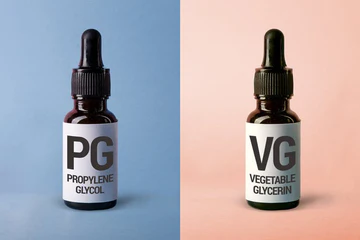
Most e-liquids primarily consist of PG, VG, flavouring, and possibly nicotine. PG stands for Propylene Glycol and VG stands for Vegetable Glycerin. These two ingredients make up the base in almost all vape liquids and work together as the foundation for the entire vaping experience.
PG is a relatively thin liquid, which is particularly good at carrying flavour and nicotine. Therefore, liquids with high PG content are often perceived as more intense in flavour. PG is also the ingredient that typically gives the classic throat hit that many former smokers associate with the feeling of traditional cigarettes. Many users who are just starting to vape therefore prefer liquids with a higher PG ratio because the experience feels more familiar.
Because PG is a thin liquid, it works especially well in smaller coils and pod systems. Small coils have smaller liquid intakes and operate at lower wattages, and here the thin consistency helps the liquid quickly penetrate the cotton around the coil. If the liquid is too thick for the coil, the cotton cannot absorb the liquid quickly enough, which can lead to dry hits or burnt taste.
VG works differently. Vegetable Glycerin is a thicker and smoother liquid, which is primarily responsible for vapour production in an e-cigarette. The higher the VG content a liquid has, the larger and denser the vapour clouds typically become. VG also provides a smoother and rounder inhalation with less throat hit. Therefore, high VG is especially used in sub-ohm e-cigarettes and powerful vape mods, where the focus is often on large vapour clouds and a more full-bodied vaping experience.
VG has a natural slight sweetness and gives the vapour a softer character, but it does not carry flavour as effectively as PG. Therefore, high VG liquids often require more heat and more powerful coils to deliver maximum flavour intensity. Modern mesh coils and sub-ohm tanks are specifically designed for this type of liquid and can produce extremely powerful flavour even with very high VG content.
When buying e-liquid, you will often see a PG/VG ratio indicated on the bottle. This ratio tells you how much of the liquid is made up of PG and VG respectively. A 50/50 liquid, for example, consists of equal parts PG and VG and is among the most popular blends on the market.
50/50 e-liquids are particularly popular because they provide a good balance between flavour, throat hit, and vapour production. This type of liquid works well in most pod systems and coils over 1.0 ohm and is therefore often the best choice for beginners. Many nicotine salts and classic MTL liquids are produced precisely as 50/50 blends because they provide a stable and versatile experience.
For more powerful sub-ohm vaping, liquids with higher VG content are typically used, such as 70VG/30PG. These liquids are thicker and produce much more vapour. The higher amount of VG also provides a smoother inhalation and less throat hit, which is important at high wattages and large amounts of vapour.
However, if you use a high VG liquid in a small coil or a pod system, the liquid may be too thick to function optimally. This can lead to leakage problems, poor liquid supply, or burnt coils. Therefore, it is important to choose a liquid that suits the type of coil and e-cigarette you are using.
Nicotine naturally also plays an important role in e-liquid. Some liquids are completely nicotine-free, while others come in various strengths depending on the user's needs. Higher nicotine strengths are often used in small e-cigarettes and MTL setups, where vapour production is more limited. In sub-ohm devices, lower nicotine strengths are usually used because the large vapour production provides a much more intense nicotine absorption.
Many new vapers are surprised at how differently the same e-liquid can taste in different e-cigarettes. This is partly due to differences in coils, temperature, wattage, and airflow. Some coils highlight sweet notes better, while others provide more cooling or a warmer and more intense flavour. Mesh coils, for example, often give a richer flavour and faster heating than traditional spiral coils.
Therefore, vaping is largely about experimenting. It is quite normal to try different PG/VG mixes, coils, and wattage settings before finding the combination that best suits one's personal preferences.
The best vaping experience occurs when e-liquid, coil, and wattage work well together. When the liquid matches the coil and the device, you get better flavour, more stable vapour production, and longer coil life. At the same time, the risk of problems such as leakage, spitting, and dry hits is significantly reduced.
Once you understand how e-liquid works, it becomes much easier to choose the right vape liquid for your e-cigarette and get the best possible experience with vaping.